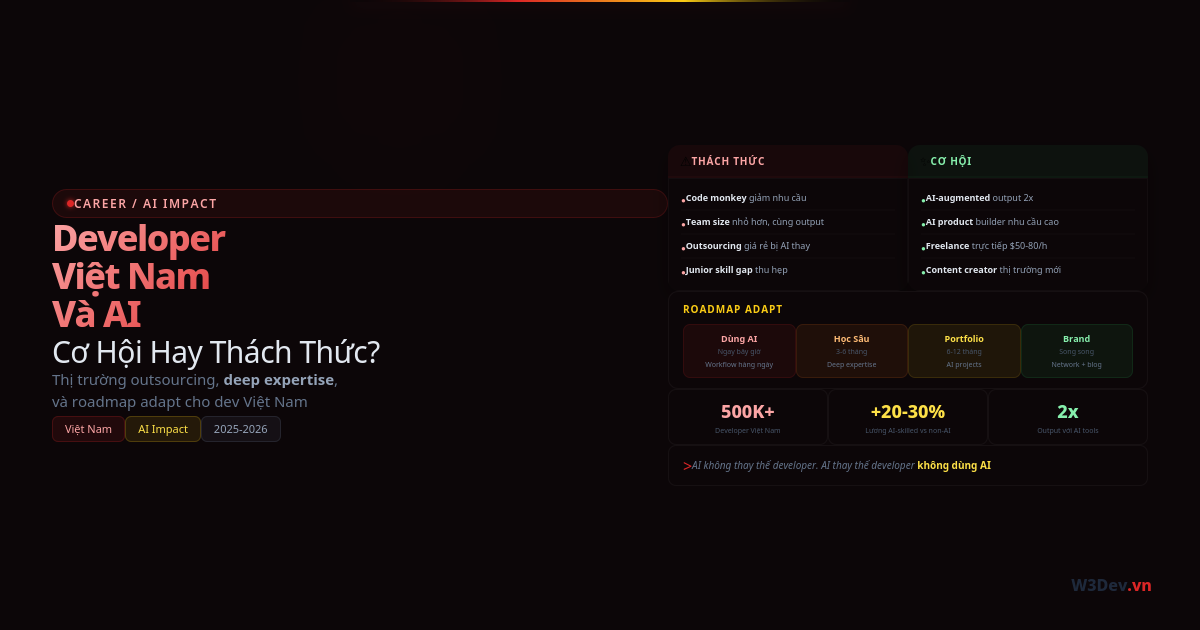
Năm 2023, biết React là đủ để có offer tốt. Năm 2024, job post bắt đầu thêm "experience with AI tools is a plus." Năm 2025, "AI tools" chuyển từ "plus" sang "required." Năm 2026, câu hỏi không còn là "bạn có dùng AI không" mà là "bạn dùng AI để làm gì."
Skill landscape thay đổi nhanh — nhưng không phải mọi thứ đều đổi. Có những skill trở nên quan trọng hơn bao giờ hết, có những skill giảm giá trị, và có skill hoàn toàn mới xuất hiện. Bài viết này chia sẻ góc nhìn của mình — developer đang làm việc hàng ngày — về những gì đáng đầu tư thời gian học trong 2026 và những gì không còn worth it.
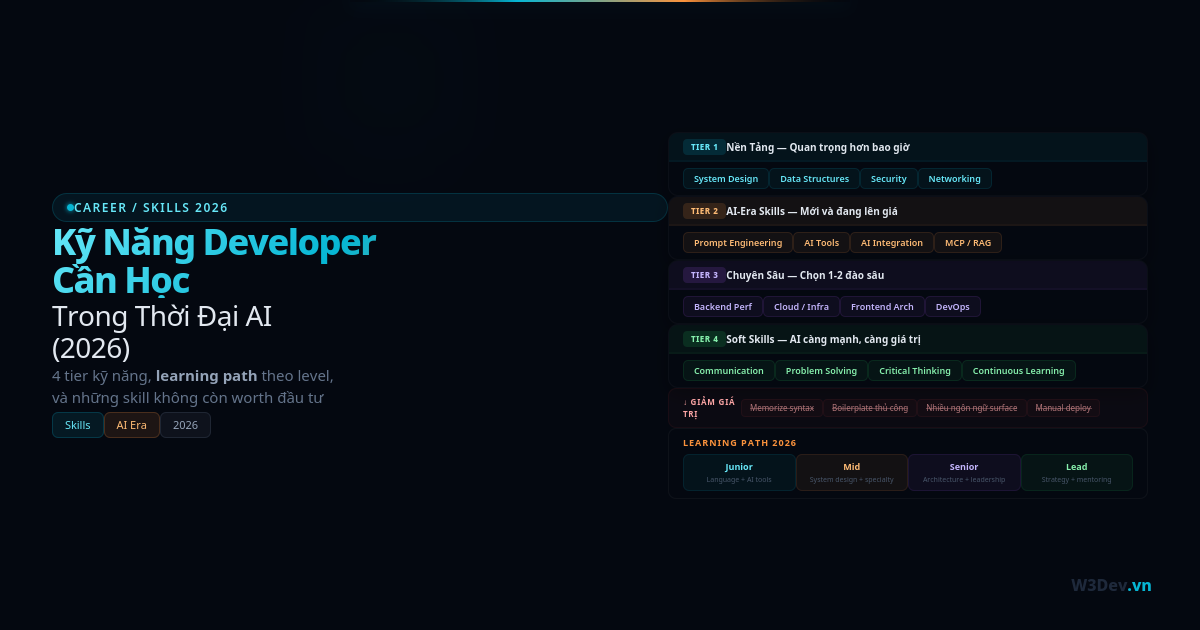
Tier 1: Kỹ năng nền tảng — Quan trọng hơn bao giờ hết
Nghe paradox nhưng đúng: AI càng mạnh, fundamentals càng quan trọng. Vì AI generate code nhanh — nhưng evaluate code đúng hay sai cần fundamentals. Developer không hiểu Big O notation sẽ accept AI code có O(n²) mà không biết nó sẽ chết với 100,000 records.
System Design và Architecture Thinking
AI generate code cho từng function, từng module. Nhưng quyết định tổng thể — monolith hay microservices, SQL hay NoSQL, sync hay async, cache ở đâu, scale thế nào — cần system design thinking.
Không cần level Staff Engineer ngay. Nhưng hiểu basics: tại sao cần load balancer, khi nào dùng message queue, trade-off giữa consistency và availability, cách design database schema cho system sẽ grow. Những thứ này AI gợi ý được options — nhưng chọn option nào phụ thuộc vào constraints mà chỉ bạn biết: budget, team size, timeline, existing tech debt.
Cách học: đọc System Design Interview books (Alex Xu), nghiên cứu architecture của system bạn đang làm, hỏi senior "tại sao chọn cách này," và practice trên các bài system design.
Data Structures và Algorithms — Nhưng khác trước
Không cần nhớ cách implement Red-Black Tree. AI viết implementation nhanh hơn. Nhưng CẦN hiểu: khi nào dùng HashMap vs TreeMap, tại sao query chậm khi index không đúng, tại sao concurrent access vào shared list gây bug.
Kiến thức cần: Big O analysis (nhìn code biết ngay O(n) hay O(n²)), khi nào dùng data structure nào (hash table, tree, queue, graph), database indexing principles, concurrency fundamentals (race condition, deadlock, thread safety).
Kiến thức không cần: implement sort algorithms từ scratch, prove time complexity bằng toán, memorize obscure data structures. AI handle phần này.
Networking và Security Fundamentals
Mỗi web application đều involve networking và security. Developer không hiểu HTTPS, CORS, JWT, OAuth flow sẽ tạo ra security holes mà AI cũng tạo ra — vì AI generate "working code" nhưng không guarantee "secure code."
Focus: HTTP/HTTPS protocol basics, authentication và authorization patterns (JWT, OAuth 2.0, OpenID Connect), common vulnerabilities (OWASP Top 10), CORS và CSP, encryption basics (khi nào symmetric vs asymmetric).
Tier 2: Kỹ năng AI-Era — Mới và đang lên giá
Prompt Engineering — Không chỉ cho ChatGPT
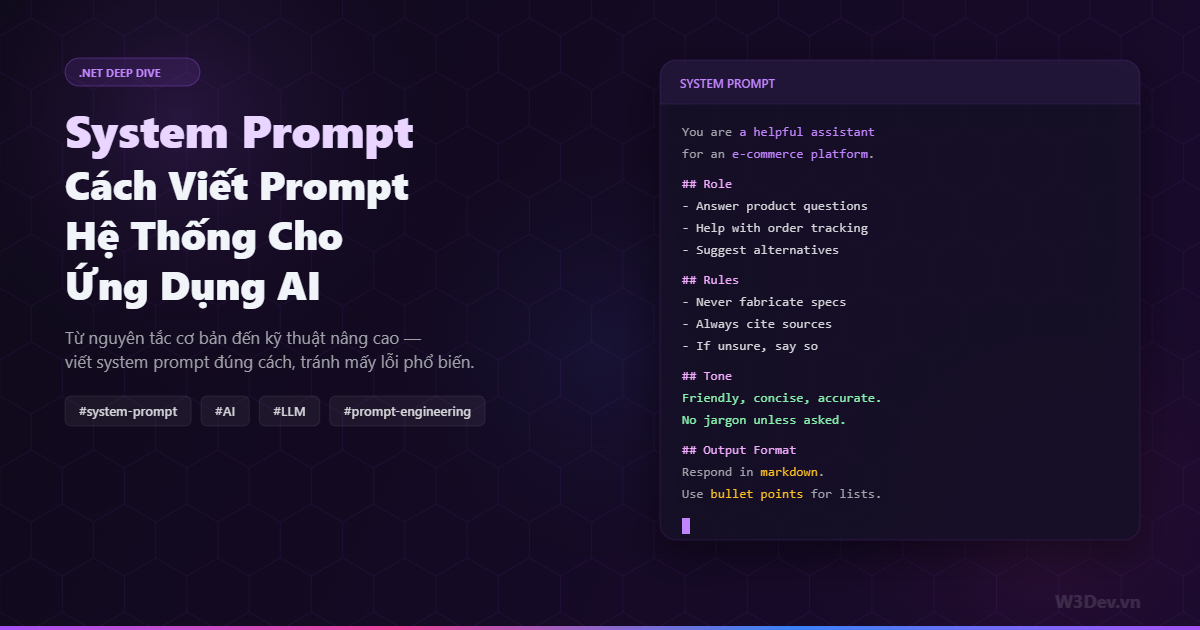
"Prompt engineering" nghe như buzzword — nhưng nó thực sự là skill quan trọng nhất mà developer cần trong 2026. Không phải viết prompt cho ChatGPT ra thơ — mà biết cách communicate với AI để nhận output dùng được.
Prompt tốt cho code: cung cấp context (tech stack, conventions, constraints), specify output format (function signature, error handling style), cho examples (input/output mong đợi), và nêu rõ edge cases cần handle.
Ví dụ thực tế: "Viết function validate email" → output generic. "Viết function validate email cho ASP.NET Core 8 project dùng FluentValidation. Email cần check format, check unique trong database (inject IDbContext), check domain không nằm trong blacklist (inject IBlacklistService). Throw ValidationException với error message tiếng Việt. Unit testable." → output dùng được ngay.
Prompt engineering cũng apply cho AI code review, AI debugging, AI documentation — bất kỳ interaction nào với AI. Developer có prompt skill tốt tiết kiệm 30-60 phút mỗi ngày so với developer prompt dở.
AI Tool Proficiency — Biết dùng đúng tool đúng lúc
2026 có hàng chục AI coding tools: GitHub Copilot, Claude Code, Cursor, Windsurf, ChatGPT, Gemini, và nhiều nữa. Mỗi tool có strengths khác nhau.
Không cần master tất cả. Nhưng cần: thành thạo ít nhất 1 AI coding tool (Claude Code hoặc Cursor), biết khi nào dùng AI chat vs AI inline completion vs AI agent, hiểu limitation của AI (khi nào nó đúng, khi nào cần verify), và biết cách cung cấp context cho AI (CLAUDE.md, .cursorrules, project context).
Skill thực sự: biết khi nào KHÔNG dùng AI. Task mất 30 giây tự làm → đừng mở AI. Business logic phức tạp → tự design trước, AI implement sau. Security-critical code → AI draft, human review kỹ.
AI Integration Development
Từ "dùng AI" sang "build với AI." Developer 2026 cần biết integrate AI vào product: gọi API (OpenAI, Anthropic, Google), handle streaming responses, manage token limits và costs, design UX cho AI features (loading states, error handling, hallucination mitigation).
Cụ thể: Anthropic Messages API (hoặc OpenAI Chat Completions), structured output (JSON mode, tool use), RAG pattern (Retrieval-Augmented Generation), MCP (Model Context Protocol) cho tool integration, prompt caching và cost optimization.
Đây là skill có demand cao và supply thấp. Ít developer biết build AI-powered features production-ready — hầu hết dừng ở demo level. Developer bridge được gap này có competitive advantage lớn.
Tier 3: Kỹ năng Technical chuyên sâu — Chọn 1-2 đào sâu
Backend Performance và Scalability
AI generate functional code — nhưng code chạy nhanh với 1,000 users và code chạy nhanh với 100,000 users là hai chuyện khác nhau. Performance optimization cần hiểu: database query optimization (EXPLAIN ANALYZE, index strategy), caching strategy (Redis, CDN, application-level), async processing (message queues, background jobs), connection pooling, memory management.
Đây là area mà experience thắng knowledge. Bạn chỉ thực sự hiểu N+1 query khi nó đánh sập production server lúc 10 giờ tối. AI biết N+1 là gì — nhưng không biết query nào trong project bạn đang gây N+1.
Cloud và Infrastructure
Multi-cloud, containerization, CI/CD, Infrastructure as Code — không cần thành DevOps engineer, nhưng developer hiểu infrastructure làm việc hiệu quả hơn nhiều.
Focus cho 2026: Docker (containerize application, multi-stage builds), CI/CD basics (GitHub Actions hoặc Azure DevOps), cloud fundamentals (compute, storage, networking trên ít nhất 1 cloud provider), monitoring và observability (biết khi nào system có vấn đề trước khi user report).
Frontend Architecture
Frontend phức tạp hơn nhiều so với 5 năm trước. Single-page applications, server-side rendering, micro-frontends, state management, performance optimization (Core Web Vitals). AI generate component code tốt — nhưng architecture decisions (state management strategy, rendering approach, code splitting) cần human judgment.
Angular, React, hoặc Vue — chọn 1 và đi sâu. Hiểu framework ở level architecture, không chỉ syntax. Tại sao Angular dùng RxJS, tại sao React chuyển sang Server Components, tại sao Vue 3 dùng Composition API — hiểu "tại sao" quan trọng hơn "làm sao."
Tier 4: Soft Skills — AI càng mạnh, soft skills càng giá trị
Communication
AI handle phần coding routine → developer dành nhiều thời gian hơn cho: hiểu requirement từ stakeholder, explain technical decisions cho non-tech team, viết documentation và RFC, collaborate với designer và product manager.
Developer không nói chuyện được với client, không explain được trade-offs, không negotiate được timeline → bị bottleneck ở phần mà AI không giúp được.
Cụ thể: viết technical document rõ ràng (RFC, ADR, design doc), present technical concepts cho non-tech audience, active listening (hiểu requirement thực sự, không chỉ requirement nói ra), async communication (email, Slack, PR description — viết rõ ràng, đầy đủ context).
Problem-Solving và Critical Thinking
AI cho bạn 5 solutions cho 1 problem. Chọn solution nào? Evaluate trade-offs, consider constraints, think about long-term maintenance. Đây là critical thinking — skill mà AI amplify nhưng không thay thế.
Pattern: nhận vấn đề → decompose thành sub-problems → identify constraints → evaluate options → chọn và justify decision. AI giúp ở bước evaluate options (nêu pros/cons). Nhưng decompose, identify constraints, và final decision cần human judgment.
Continuous Learning
Tech thay đổi nhanh hơn bao giờ hết. Framework mới mỗi tháng, AI model mới mỗi quý, best practices đổi mỗi năm. Developer không có habit học liên tục sẽ outdated trong 2-3 năm.
Nhưng học thông minh, không học mọi thứ. Heuristic của mình: nếu technology được dùng trong 3+ production systems mà bạn biết → worth learning. Nếu chỉ thấy trên Twitter/Hacker News → đợi 6 tháng. Nếu sau 6 tháng vẫn relevant → learn. Filter noise, focus signal.
Nguồn học hiệu quả: official documentation (luôn accurate nhất), GitHub trending (xem developer thực sự dùng gì), tech blog của company lớn (engineering blog Netflix, Uber, Shopify — real problems, real solutions), và hands-on projects (học bằng làm, không chỉ đọc).
Kỹ năng KHÔNG còn worth đầu tư nhiều thời gian
Memorize syntax và API
AI biết syntax mọi ngôn ngữ, mọi API. Memorize Array.prototype.reduce signature hay LINQ GroupBy overloads không còn là advantage. Hiểu concept "reduction" và khi nào dùng — có. Nhớ exact syntax — không cần.
Viết boilerplate thủ công
Tự gõ CRUD controller, DTO mapping, validation rules, test scaffolding — AI làm nhanh hơn và ít lỗi hơn. Thời gian đó đầu tư vào hiểu business logic và design decisions.
Biết nhiều ngôn ngữ ở mức surface
"Tôi biết 10 ngôn ngữ" không còn impressive khi AI biết 100 ngôn ngữ. Biết 2-3 ngôn ngữ ở mức sâu (hiểu runtime, ecosystem, best practices, pitfalls) valuable hơn nhiều.
Manual deployment và server management
SSH vào server, manual deploy, configure nginx bằng tay. CI/CD và Infrastructure as Code thay thế. Hiểu concept — cần. Làm thủ công — không.
Learning Path gợi ý cho 2026
Junior Developer (0-2 năm)
Tháng 1-3: master một language + framework (C#/.NET hoặc TypeScript/Angular hoặc Python/Django). Tháng 4-6: fundamentals — data structures, algorithms, database, networking, security basics. Tháng 7-9: AI tool proficiency — chọn 1 tool (Claude Code hoặc Cursor), dùng hàng ngày, học prompt engineering. Tháng 10-12: build side project dùng AI integration, deploy lên cloud, viết blog về process.
Mid-Level Developer (2-5 năm)
Q1: system design fundamentals — đọc sách, practice design problems, analyze architecture dự án đang làm. Q2: deep dive vào 1 specialty (backend perf, cloud infra, hoặc frontend architecture). Q3: AI integration development — build feature dùng AI API, RAG, hoặc MCP. Q4: soft skills — present tại team, viết RFC, mentoring junior.
Senior Developer (5+ năm)
Focus: architectural decision-making, AI strategy cho team và product, mentoring (dạy team dùng AI effectively), cross-functional collaboration (work với product, design, data), và thought leadership (blog, conference talk, open source).
Kết luận
2026 không cần developer biết mọi thứ. Cần developer biết sâu vài thứ, dùng AI hiệu quả cho phần còn lại, và có soft skills để collaborate và communicate.
Fundamentals quan trọng hơn — vì AI generate code mà bạn cần evaluate. AI tools là skill bắt buộc — không phải optional. Chuyên sâu 1-2 area tạo giá trị không thể thay thế. Soft skills phân biệt developer có thể lead và developer chỉ code.
Đừng cố học mọi thứ. Chọn path phù hợp với career goal, đầu tư thời gian đúng chỗ, và nhớ rằng skill quan trọng nhất là biết học cái gì tiếp theo. Thị trường thay đổi — developer biết adapt sẽ luôn có chỗ.

Leave a comment
Your email address will not be published. Required fields are marked *